Products, Platforms and the Systems Behind Them
Thirteen years of products taken to launch. Grouped by what the work actually was rather than by employer — because the through-line is the type of problem, not the logo.
Product Owner — the role that owns a product across its full lifecycle: problem framing, discovery, system design and functional specification, prototyping, engineering coordination, stakeholder governance, UAT, launch, and hand-over to operations with runbooks and observability. Delivery project managers were staffed alongside for schedule and vendor management. In Korea the same role is commonly titled Planning Owner, which is how it appears on most of these contracts.
Sources for figures on request.
Data & AI-enabled Products
2026 —
Product Owner · Sejong MaaS-Based Super App
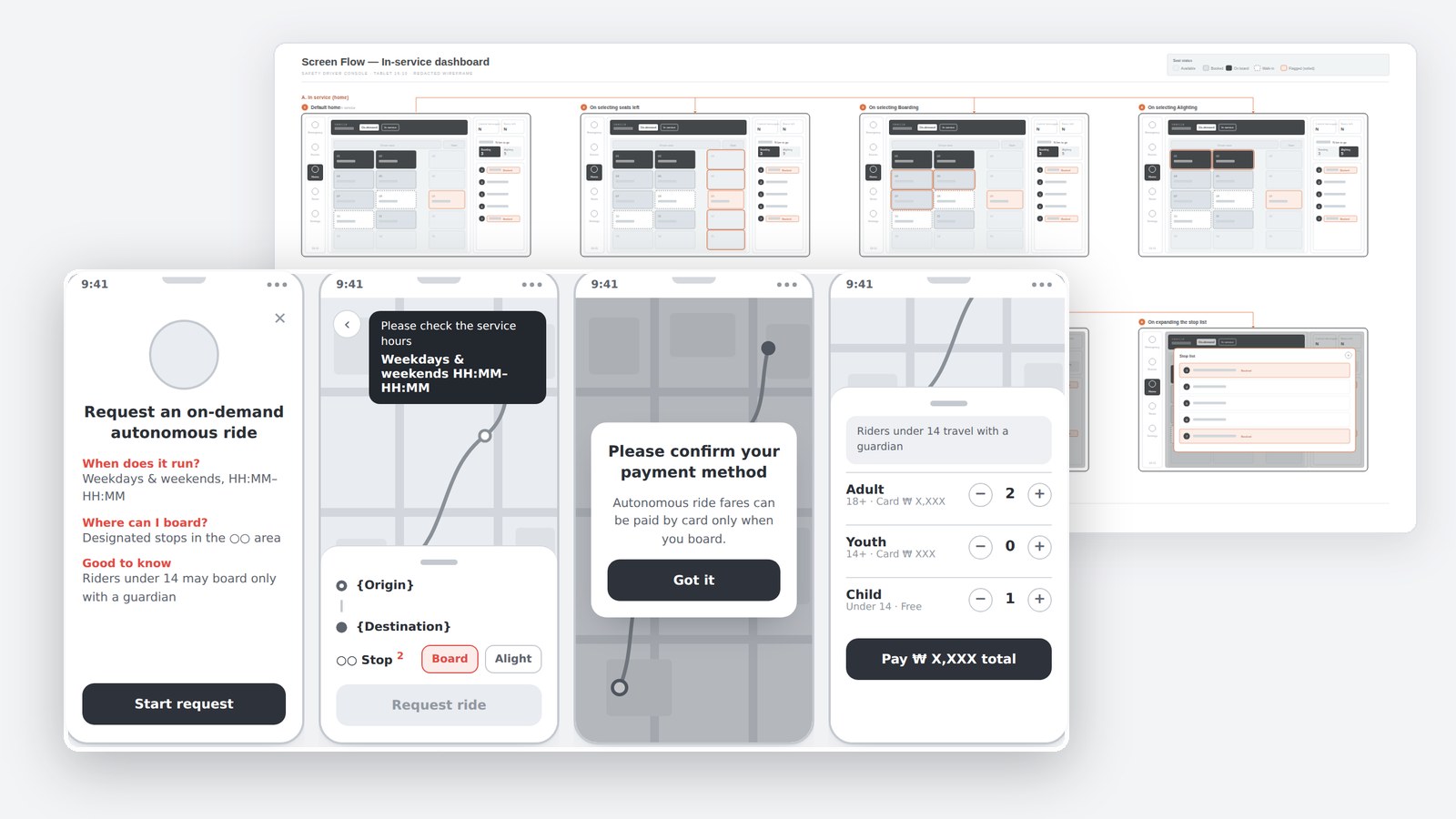
The resident-facing agentic AI super app for Sejong’s national pilot smart city — a KRW 3.16 trillion urban development covering hardware, physical systems and 21+ constituent services. This app is the citizen entry point into that city; the constituent services are its downstream dependencies. Captive install base at 2029 opening: ~22,000 residents / ~10,000 households in the 5-1 Living Zone (2.74 km²) — installing the app is a precondition of entry, because access control for the smart-city core zone runs through it. Positioned as an export testbed for smart-city stakeholders targeting overseas rollout, with Sejong’s ~390,000 citywide population (500,000 by 2030) as the domestic scale-out path. Currently in delivery ahead of that opening. MaaS and autonomous driving, car sharing, e-bike sharing, EV charging, food delivery, geo-contextual recommendations and walking rewards composed as one journey via an agent orchestration layer over the constituent service APIs. Physical AI (vehicles) and software AI (agents) specified as one integrated system on both sides of the glass.
MOLIT · Sejong · LG CNS
2025
Product Owner · Busan Autonomous MaaS
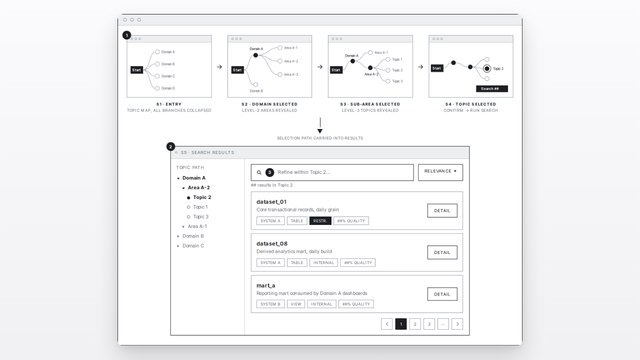
The first product I have owned that lives on top of a physical AI system rather than beside one. The autonomous shuttle is an upstream dependency: its Operational Design Domain (Level 4) — which roads, which speeds, which weather — is set at the vehicle and cannot be stretched by software. So I inverted the specification order: model the vehicle’s envelope first, derive the fleet operations console from it, then design the rider-facing app against a set of possibilities the operations layer had already declared feasible. Two apps as peers of each other, both juniors to the vehicle. The seam between the shuttle and city buses was specified as first-class product surface, not glue. Operating envelope: 4 vehicles inside a defined Operational Design Domain (Level 4), 2 fixed routes at 4.8 km and 4.6 km. Operational record at the transition to paid service: 6,835 riders, zero safety incidents, 65.9% intent-to-return, on a KRW 9.4 billion programme.
MOLIT · Busan · LG CNS
2026
Product Owner · Data Governance Portal
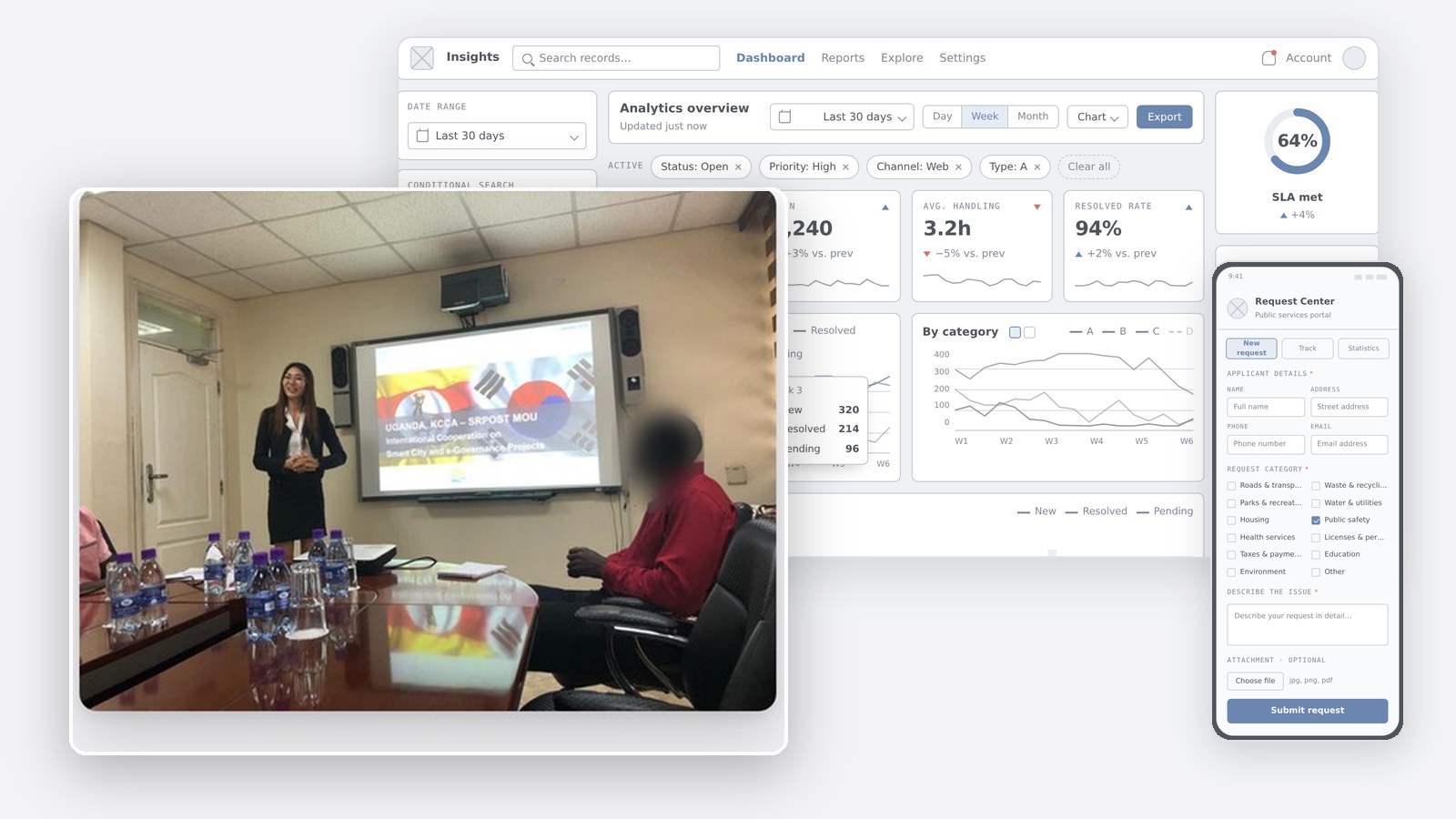
The AI-readiness prerequisite nobody sees: no agent — and no RAG on top of it — is trustworthy on data the business cannot name, locate or trust. At LG H&H, Korea’s largest household-goods manufacturer and retailer, the product estate is vast and siloed end to end, with IT and the business naming the same entity differently — a canonical-model problem, not a search problem. Rather than consolidate the underlying systems, I framed the portal as a governance layer over what already existed: business glossary negotiated asset by asset, end-to-end data lineage graph, a named data steward per dataset, DQ rules derived from business logic, and semantic search over business terms. The disagreement between IT and the business was itself the deliverable — converted asset by asset into a decision record. Foundational data platform for agentic AI, taken from discovery through data modelling and service design to a working reference implementation.
Recreated for this portfolio with fictional data — rebuilt from scratch, using no client files or confidential material. 19 Aug 2026.
LG H&H · LG CNS
Regulated Public Services
2018—19
Project Manager · Kampala Citizen Participation
A citizen-request routing system with an accountability surface on top. Citizens write freely through whatever channel they already use — the city’s own web channels, WhatsApp and others — each format different and none of them structured. An AI classification pipeline reads that unstructured intake: text embeddings and named-entity recognition (NER) extract entities, a hybrid rules-plus-model classifier assigns the responsible officer, a confidence threshold gates auto-dispatch, and low-confidence items fall through to a human-in-the-loop review queue. Every channel is normalised and PII-masked at ingest; every human reassignment feeds the next model version — a closed feedback loop with a versioned model lifecycle. The same queue is exposed back to the city as evidence: request volume, keywords and trend. I participated in winning the KCCA–SR Post engagement directly and then owned it as Product Owner through to on-site deployment.
I presented the plan to KCCA’s Executive Director and — after the leadership change — again to her successor following Seoul Smart City Summit 2019 — forum.seoul.go.kr. Photograph: my own — the second presentation, to her successor at KCCA.
KOSME · SRPost · Kampala Capital City Authority, Uganda
2019—20
Principal Consultant · Kampala Smart Parking Study
The five-year TCO model I co-authored put a number on the decision: USD 2.63 million total — USD 475,431 CapEx in year 1 (plan), USD 1,585,776 CapEx in year 2 (build), USD 190,293/yr OpEx from year 3 — across roughly 5,782 public on-street spaces. Would paid smart parking work in Kampala: find an open space online, pay by mobile money? Parking is the practical end of smart mobility — a car circling for a space is traffic. The proposal I contributed to won WeGO’s open bid; the study was then delivered as a co-authored consultant piece and the final report is catalogued in the U.S. DOT ITS knowledge database.
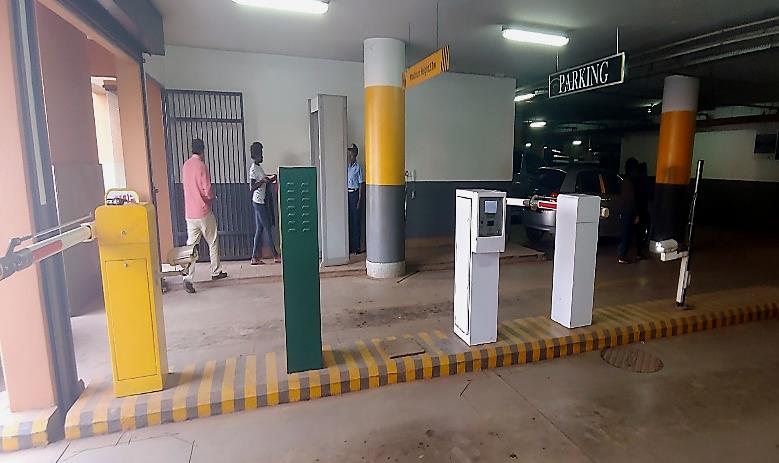
Won in WeGO’s competitive bidding on a proposal I built single-handedly; I then co-authored the study as principal consultant (final report, Jan 2020), catalogued in the U.S. DOT ITS evaluation database with the full author list — itskrs.its.dot.gov · we-gov.org. Photograph: Picture 15 of the study’s final report, which I co-authored — parking entry and exit at Acacia Mall, Kampala. Final-Report_WeGO-FS-2019-Kampala.pdf, we-gov.org.
WeGO · SRPost · Kampala Capital City Authority, Uganda
2024—25
UX & Service Planner · NongupEZ Farming Grants
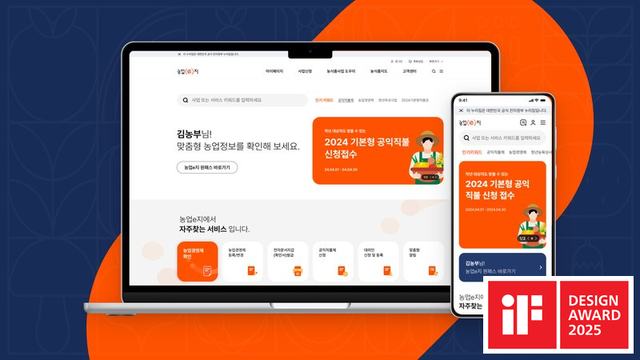
Phased rollout: lookup and personalised grant guidance went live Jan 2025; fully paperless new and change applications on 3 Nov 2025, backed by ~130 digital service desks and ~50 kiosks as the assisted-digital channel for older farmers. The system now serves 1.84 million government-registered farming operators, with roughly 1 million registration filings a year migrated off paper. Hyper-personalisation is a systems problem, not a UI one: tens of thousands of central and local programmes, each with its own eligibility rulebook, encoded into a rules engine and scored by semantic similarity per applicant — running under a P95 latency budget that has to hold at peak-load. Explainable-by-default: every eligibility decision cites the rule and the citizen data it fired on, so the whole thing is auditable. iF Design Award 2025, User Experience.
Shown: the winning entry as published on iF Design — ifdesign.com, iF Design Award 2025. I am credited on the entry’s design team.
Ministry of Agriculture · LG CNS
Digital Channels & Payments
2022—23
Product Owner · Vehicle Dealer App & Online Shop
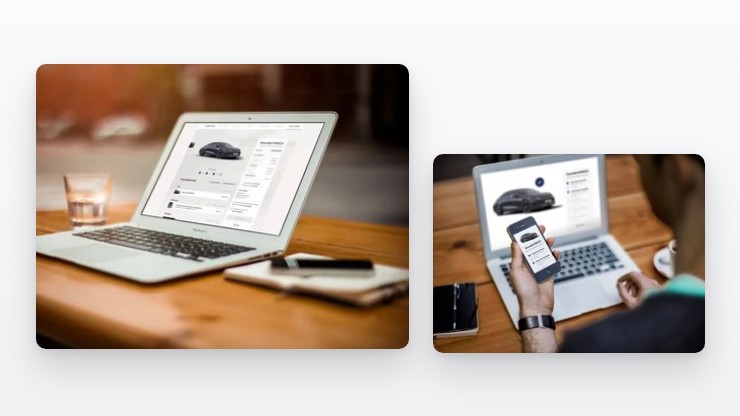
A greenfield operator backend for Cl!ck to Buy — Hyundai’s online vehicle sales in Singapore — and new dealer sales apps (a dealer point-of-sale system) for Thailand and the Philippines. These are channel systems: a measurable share of each market’s registrations flows through them, not the whole of it. Programme-level market growth over this period: Singapore Hyundai registrations 333 → 941 units H1 2023 → H1 2024 (2.8× YoY); Philippines 12,023 units in 2024 (+32% YoY); Thailand targeting 3,000 units for 2026 vs. ~2,300 in 2025 (+30% plan). You cannot write a functional spec for a vehicle sales system without owning two things completely: the domain model itself — catalogue, quotation, order, contract, ERP and finance linkage — and the local go-to-market process (how each market sells, takes payment, registers and delivers a car).
Shown: the customer-facing Cl!ck to Buy. My scope was the operator system behind it.
Imagery © Hyundai Motor Europe — hyundai.com/eu
Hyundai Motor Group · Hyundai Autoever
2025
Product Owner · LG.com Multi-Shop
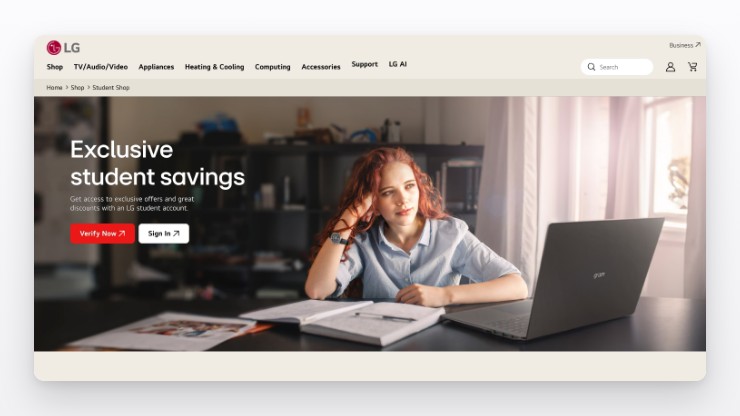
Platform modernisation within LG.com — a direct-to-consumer storefront estimated at ~USD 2.3 B annual online GMV worldwide (Grips Intelligence, 2025). The verified-access shops for student, business, key-worker and partner tiers are the gated commerce layer I planned within that platform, across a 15-market topology. The strategy was a platform contract: what the eligibility verification service, the shop information architecture and the UX pattern library must share globally, and which extension points each market may override under a controlled variation model. Holding that contract was continuous platform-governance negotiation with global HQ, not a one-time specification. Reverse-engineered from the legacy stack up.
Shown: the live Student Shop on LG.com UK — one of the verified-access shops delivered through the platform enhancement I planned.
LG Electronics · LG CNS
2021
Product Owner · Game Wallet Payments
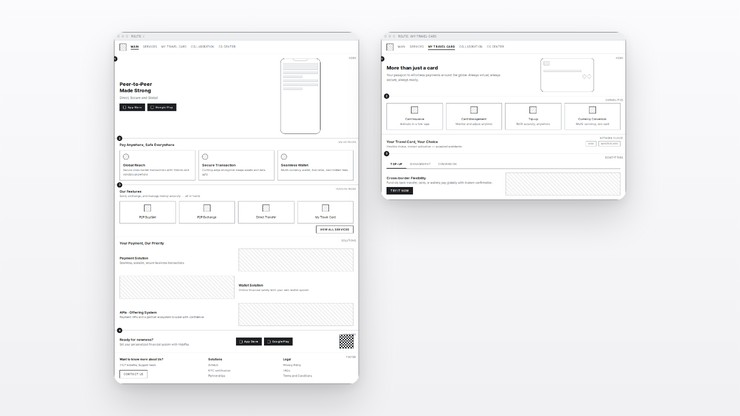
A wallet built inside a game business, productised into a payment method usable outside it — an embedded-finance play. Three domain services on the backing platform: wallet (KYC-gated account creation, account state machine, real-time balance), transactions (transfer, top-up, payment — event-driven, asynchronous, idempotent), and banking integration (open banking APIs, PG, Visa/Mastercard rails). The web platform is the consumer surface over that architecture: end-to-end encryption, MFA and secure custody exposed as trust primitives rather than as plumbing, so marketing can move at its own velocity without redefining the security contract.
Shown: screen wireframes of the public marketing site, holapay.uk — reconstructed for this portfolio from the published pages; no client files or confidential material used.
Market Grid LLC · ArctX LLC
2023—24
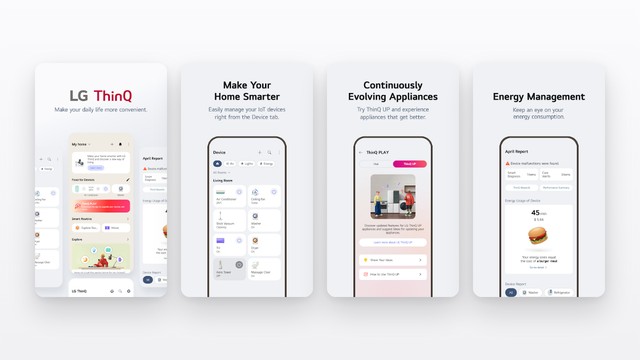
Product Lead · ThinQ 5.0 Admin
The operator console behind an IoT platform with 2.31 M MAU in Korea alone (+31.9% YoY) and 30 M+ global downloads. Connected-device install base scaled ~1.54 M → ~2.72 M air conditioners in 18 months. An IoT operations platform is specified stack-first, not screen-first: connectivity and message ingestion via an MQTT broker, device shadow and device-state management, an event-driven automation rule engine, and the operator admin console on top. Specified in English as the platform contract for distributed engineering teams; led a team of thirteen.
Shown: the House Appliances Remote Control & Monitoring app LG ThinQ on Google Play — play.google.com. My scope was the global operations system behind it, specified in English.
LG Electronics · DXC
2020—23
Research & Technical Writing · Customer Evidence Programme
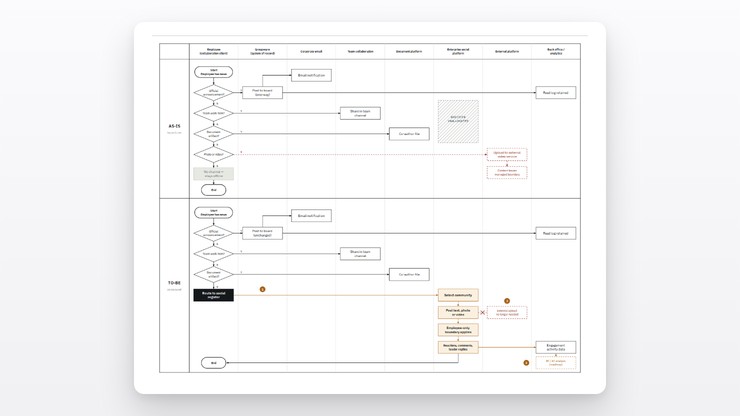
Reference-backed deals close 20–50% more often and 10–30% faster than deals without them — producing that reference material at scale is what this programme is. Many enterprise customers, one repeated method: study the Microsoft product, work out how it lands in that customer's industry, benchmark the alternatives, research the company — then draw the architecture before the interview rather than after it. The interview is where that drawing gets confirmed or corrected; only then is the case concrete enough to write, in Korean and English.
Shown: the channel-routing process definition — drafted before the interviews as a hypothesis, then confirmed and corrected against them, before the writing. Reconstructed for this portfolio; client and product names withheld. One of the published stories is linked below.
Microsoft Asia-Pacific · Wings4U